
One of my ongoing gags with friends is saying, “This wasn’t the cyberpunk dystopia I was promised. There’s supposed to be more neon and cyberwear.” A recent video takes on Cyberpunk and its reliance on visuals essentially created in the 80’s and, if I had to give it a tagline, it would be my cyberpunk gag. But here’s my critique of the critique:
He’s not talking about writing cyberpunk, or the themes of cyberpunk, but the visuals of cyberpunk. The aesthetic. It’s an aesthetic which is honestly now in its second and third generation, as people are being inspired by Blade Runner to create their own versions of the film. Altered Carbon is taken to task in this way, but I bet every one of the artists and designers there thought, “Oh, cool. Now I get to make my version of the city from Blade Runner.”
They are trying to capture a nostalgic feeling when the fears of cyberpunk (Invasive technology being used by unfettered capitalism to manipulate, and sustain, class differences or to create new phenomenon we are not yet mature enough to deal with) were easy to see and externalized. They weren’t here, and part of our lives.
Check out one of my favorite videos of recent years, Starcadian’s “Chinatown.” It is set in the ‘future’ of 1995 and talks about a cyberpunk world, but because it couldn’t afford to re-create Los Angeles as “Ridleyville” you see the current LA with a few buildings added in, some flying cars, and some drones. It’s nostagic, but I think it also points to a type of cyberpunk we need: one grounded in the world, stripped of the ‘aesthetic’ to just deal with the themes.
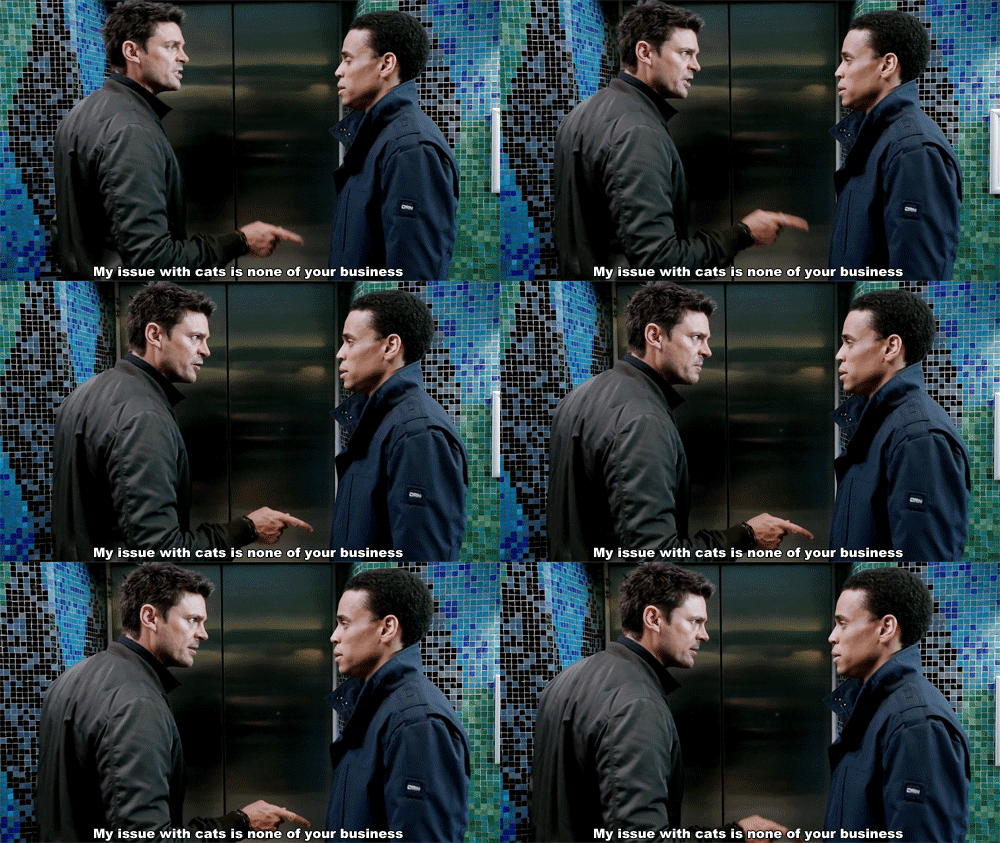 Mr. Robot is pointed out as one example, but I had another as well: The one season series Almost Human with Karl Urban and Michael Healy. The restraints of TV kept them away from the grand soaring metropoli of cinematic cyberpunk, but we saw other things in use: ubiquitous advertisement and surveillance (in one episode, used to target guided bullets via personalized advertising), home drug printing, masks designed to foil facial recognition.
One of my favorite scenes involved Karl Urban placing sticky notes all over his kitchen. Virtual sticky notes. It’s something I could actually see people buying into 30 years from now, not realizing that the folks making the ‘smart cabinets’ are also gleaning statistical data about your every habit. Oh, they can’t see what you are writing, but hey can compare when you’re using the product against data they purchased from your smart fridge about eating stress, maybe start profiling you for the design of the new smart stove…
Look at the Ghost in the Shell TV series, Stand Alone Complex. While Oshi’s film adaptation is groundbreaking in many ways, for me SAC is brilliant in it lets us have it both ways. Yes, we’ve got massive skyscrapers and Asian urban planning on display, but we also see homes in the suburbs and the countryside. Everything isn’t one giant city. For all the advanced cybernetics, they still have Starbucks. People live here, and it’s not bad for most folks.
In some ways, the granddady of this less soaring, more grounded style of cyberpunk is Kathryn Bigelow’s Strange Days. Set in what was then the near future, it actually looks a lot more like the present than most would admit. The constant police presence reminds me of actual neighborhood blockades where folks were asked to show ID’s and prove they lived in the area. Imagine Stop and Frisk taken to a new level. The TV’s are wide screen. And the new tech introduced, the sense wire which lets you record a person’s experiences, is used to talk about real racial divisions. This is just after Rodney King, but prescient of what we saw in Baton Rouge after police shootings.
People confuse thematic with the aesthetic. Which is what a lot of folks have always done with cyberpunk. And it’s easy to do when the aesthetic is so powerful and dominating. It resonates. People look at Max Headroom’s Blank Reg and see the mowhawk, and not the fact he’s someone who asked to be completely erased from every possible database so he could live the way he wanted to, without interference. Blank Reg would be an empty line in Cambridge Analytica’s data.
So, what do we do? If we’re fans of the genre, and still think it actually has more to say, what can we do?
- Accept the Nostalgia – Yes, I said it. We have to realize that there will always be a hungering for the innocent days of pink mowhawks and low-life high-tech outlaws. And if we’re just creating an extension of that nostalgia, let’s talk about why and what makes is still resonant.
- Create an Updated (and Expanded) Aesthetic – For all its CyberNostalgia, the Cyberpunk 2077 demo had things I liked a bit. Namely, all the folks on the west coast looking and speaking Spanish. Ethnic diversity. Now, imagine what Cyberpunk would look like if the aesthetic was embraced by the Latinx community? What does Phillipino cyberpunk look like? Did you know there’s a CyberFunk movement out there?
- Remember the Now – Black Mirror is as much about creating a funhouse mirror on our behaviors as anything else. So, too, should the genre. Cyberpunk, like all good science fiction, is about confronting the now by looking at what could happen if things keep going the way they are. Gibson’s kept up to date. Why can’t the rest of us?
Will I still be entranced by the aesthetic? Yes. I still re-watch Max Headroom. But we have to learn to separate a nostalgia for the aesthetic, and what cyberpunk was actually discussing.
As for Max Headroom, want to know my favorite episode? The election night one, where a channel was manufacturing news in order to get an endorsed candidate to win elected office…
 Biomechanoid Blues