
Warning: This post will contain levels of Doctor Who geekery, discussions of current events, Communism, illegitimate children, and talk about how works can impact the future in unimaginable ways.
You have been warned:
For Doctor Who fans of a certain age, UNIT means something very deep and abiding. To the point where, when watching the Kennedy Center touring performance of Hedwig and the Angry Inch, I noticed the lead actor had a permanent UNIT tattoo on his shoulder. Not decoration. And not the post 2005 series logo, either. The John Pertwee era UNIT – defenders of the earth and international beacon of hope.
In the latest Doctor Who special, when faced with a Dalek loose on earth and Team TARDIS needs help, the Doctor calls on UNIT and Kate Lethbridge-Stuart for backup. Alas, though, she’s told UNIT operations have ceased due to ‘disputes on funding with international partners’ but domestic armed forces are available.
That’s right. UNIT was kicked out because of Brexit.
Of course, The Daily Mail and all the internet fanboys were up in arms about this bit of political commentary, just as they have been about Doctor Who being infected with girl cooties. Oh, how they long for the classic days, when Doctor Who was free of such things and he said things like, oh,
“[Grover] realised the dangers this planet of yours is in, Brigadier. The danger of it becoming one vast garbage dump inhabited only by rats…Its not the oil and the filth and the poisonous chemicals that are the real causes of the pollution…Its simply greed.”
Sorry, folks. Doctor Who has always been political. And if there was ever a reason for this, and why it continues to be, its’ because of an self-described illegitimate Communist named Malcolm Hulke.

Others have written some excellent articles on Mac Hulke. There’s also a great biography out there. But I want to talk about the impact this man had on the current generation of Doctor Who producers, directors, and creatives. During his time as a writer, first at the end of Patrick Troughton’s run and through John Pertwee’s tenure, he was part of a cadre of writers who introduced some rather interesting ideas in what was a children’s program. Looking back at the episodes, you see discussions of imperialism, environmentalism, militarism and the rise of corporate interests.
But no one did this better than Hulke in my view. The Silurians had the Doctor committed a radical act by introducing himself and trying to start a dialog with ‘alien’ creatures. Colony in Space, even with all the Doomsday Weapon and Master bits, is still a pretty blunt attack on corporate greed driving morality. “What’s good for IMC is good for Earth.”
My favorite of his episodes is still Frontier in Space, where he dared to have an Earth Empire run by a woman, explicit confrontations between militaristic authoritarians and civilians, the imprisonment of (a surprisingly multi-cultural) dissenting party, and – for me the most radical ideas – Jo Grant’s confrontation with the Master.
How was this radical? When Jo was first introduced as the bumbling but cute audience substitute in Terror of the Autons the Master promptly hypnotized her and had her try to deliver a bomb to the Doctor. This time around, the Master – mighty rival Time Lord – tried to do the same thing again. But Jo countered, blocking his hypnosis with techniques she’d learned after their last encounter. And when that failed, he tried turning a fear amplifying device on her.
Jo Grant fought. She battled through the monsters the Master’s device projected – a device which set two space empires to war based on their fear of ‘the other – and beat it. The simple audience substitute had beaten the big bad on her will alone.
In addition, Hulke wrote two books which would become bibles for future writers. One is his book on screen and television writing (still available today and still considered an excellent reference) as well as this tome:
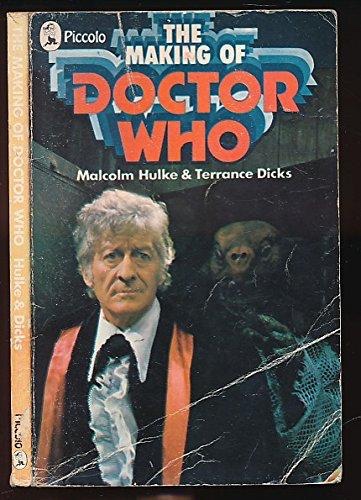
I had a later version, with Tom Baker on the cover, but this book (written with friend and collaborator Terrance Dicks), sparked the imaginations of young Doctor Who fans everywhere. Maybe I could write for the show? Maybe I could work in TV?
Who were those fans? Here are a few names: Chris Chibnal, Stephan Moffat, Russel T. Davies, Peter Capaldi, Mark Gattis, Paul Cornell – I could go on. But all should be familiar to fans of the reborn version of the series. How many writers on this show, and others, think back to Mac Hulke’s episodes and think, “How would have he done it?”
We lost Mac Hulke nearly thirty years ago. But all he created, and all he inspired, lives on. And he would not have done so without taking risks, and working with others who said, as Barry Letts did, that stories should be about something. So any time someone complains about Doctor Who getting too radical, I just imagine Mac Hulke smiling behind a typewriter.
WWMHD: What Would Mac Hulk Do?
 Biomechanoid Blues