 Full disclosure: Gemma Files is one of my favorite writers. Experimental Film is an amazing novel. Her short stories are dark delights. And her class on personal horror was an excellent experience I’d recommend to anyone interested in learning horror. She’s also a former film critic, a fellow Lake Mungo stan, and one of the loveliest people I’ve ever met at ReaderCon.
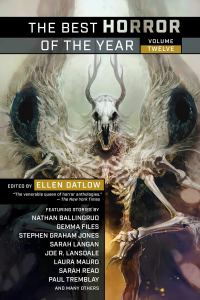
When looking for short stories to vivisection for my Horror Project, at first, I wanted to avoid Gemma’s work. I’d didn’t want to play favorites. I went though “Foundations of Fear” and didn’t really feel any of the stories there terrified me. Or even made me uneasy. I slept well after reading them. Until I started down the latest edition of the Best Horror of the Year edited by the peerless Ellen Datlow. I saw Gemma’s name listed. And I should have gone straight to her story. But I took my time, and read it with the others, and re-read it, and I realized I should have started there.
Or, to quote the narrator: “Just. Fucking. Run.”
The same should be said for anything edited by Ellen Datlow, by the by. For now, get yourself a copy of the anthology and read the short story. I’ll wait.
Done?
Good. Let’s begin.
 “The Puppet Motel” begins in a contemplative tone, with the narrator foreshadowing the end, discussing hands in the darkness, becoming onwards. It’s not until the fourth paragraph we see any version of “I” in the writing. It brings this from the cosmic to the personal in a very leisurely pace (for a short story). But it establishes the tone – literally, as the narrator is discussing an ur-sound, like the tooth-buzzing hum of a badly moored air conditioner – and advises us to act if we hear it.
“Just. Fucking. Run.”
We also have a little diversion – a story about the narrator’s father, and their encounter with the uncanny. Anyone looking for just gut level efficiency would think this was wholly unnecessary, but it’s a key part of the story: the uncanny, the strange and horrifying, is everywhere. Everyone has a tale, and everyone has a reaction to it. We get the choice to either ignore it – or to realize it’s out there, and we all have a story.
The ‘meat’ of the narrative doesn’t kick in until we’re past the introduction to the idea and the uncanny. I know there are a lot of short story writers – including myself – whose inner editors were screaming. “Your story starts three sections in!” But that assumes the story is about events, and circumstances. “The Puppet Motel” is a good reminder atmosphere and theme are crucial parts of the story. Not just “Well, this happened and then this happened…”
The next part of the tale focuses on our narrator and navigating the forces of 21st century culture and late-stage capitalism. Seriously! Trapped in a bad relationship, bereft of money, and not wanting to run home again, she agrees to become the unofficial property manager for her boyfriend’s (Gavin) friend (Greg – married to the nearly invisible Kim) illegal AirBnB properties. One is all flowers and joy. The other – the Puppet Motel – is a grey and black marble modernist nightmare. It’s a set from Hannibal pulled into the real world. This part of the story not only introduces us to the narrator’s desperation, but also the detached callousness of her boyfriend (a skeptic) and the landlord (who gets into internet fights about geek culture, to own folks with facts and logic). The key thing – and the important part of this section – is the support network our narrator has is an illusion.
Greg and Gavin are both detached, wanting the benefits of the relationship (a girlfriend, a building super) and the modern world (money from the AirBnB) without bothering to listen or get their hands dirty. They, like our other character, exploit artificial distances for their own gain. They could have been understanding, or gotten involved, but instead they shuffle the problem onto someone else. And damn the consequences.
This is where we’re also starting to get to know the Puppet Motel. The room emits a tone, psychic tinnitus, and which impacts the guests there. It’s the sound at the heart of the world but, instead of razors through flesh, it’s a needling tone akin to low EM frequencies. It’s the sound you neighbor’s air conditioner makes when it defrosts, amplified and distorted by the little brick alcove it occupies between your house and his. Gemma takes her time introducing us to the sound. She lets the sound sink into us. She lets the uncanny nature of this completely normal – if badly painted and designed – apartment start eating us. First contact is aural (the tone) and tactile (pulling hair plugs from a drain).
It isn’t until the narrator is basically thrown out by Gavin via note (“Don’t hate me!) and forced to live in the Puppet Motel when the escalations begin. Gemma avoids the ‘horrible dream’ trap to show the real nightmare is waking. The entity within the Puppet Hotel reaches out during the day. It sends the narrator screaming, naked, from the apartment. And that’s just the first stage. Next, it reaches out to her via her phone, using the Google AI voice to draw her back inside.
She finds more evidence of the the Puppet Motel’s ‘wrongness,’ including posts on AirBnB complaining about fights, oversleeping, unintended homosexual experimentation, and one person vanishing from their ‘big city vacation.’ The last item becomes important later one… But,, all through this, Greg remains a privileged absentee landlord – “Well, it’s not my fault” is his constant refrain. (Note: It’s may not be your fault, but it sure as Hell is your responsibility).
Our narrator tries to find experts on this ‘haunting without ghosts’ phenomenon, but there is no Dr. Quatermass explaining the situation in calm, stentorian tones. Just people lost and trying to connect and figure it out. All of this is done through phone calls, chats, websites. No one connects directly. It allows people to diffuse responsibility. It isn’t a story told, like the father’s tale in the beginning, but a story misheard. I also appreciate there’s no easy ending. It’s not an ‘Indian burial ground.’
All through this, the Puppet Motel (or the entity within it) keeps reaching out to our now named narrator, Laura. In fact, the first time I recall seeing the narrator’s name came from the room itself, speaking via proxy. After a second, more harrowing encounter with the entity in the room, she goes back with another human – her mother – get her things and get out. She’s decided the pretense of independence isn’t worth the nightmare of the Puppet Motel.
And then the closing – This is where the atmosphere, the stories, the sense of dread and disconnection builds. It answers nothing. We get no pat ending stating, no “The Hounds of Tindalos, as described in Petersen’s Guide to Non-Euclidean beings, have been contained.” We’re left to wonder what the entity in the Puppet Motel is – but we can guess. The only certainty we have is Laura’s last words – something from the Uncanny Valley, from the weird space, knows her name. And she must deal with it.
What did I learn from Gemma?
- Horror is both Cosmic and Personal – Gemma constantly grounds the entity/the Puppet Motel with everyday horrors. We can understand being strapped for cash, trapped in a bad relationship, and being responsible for the care of others while someone else profits from our work. This makes the entity that preys on the people in the Puppet Motel feel real, and solid. It and the Greg/Gavin’s of the world are given equal weight.
- Take your time, but leave warning signs – For some, this short story would be leisurely. It takes its time setting up the premise, introducing you to the concepts. But at every point, Gemma leaves a warning sign. “Just. Fucking. Run.” Small hints build to big disturbing moments.
- Smell, Sound, and Texture – Pay attention to the descriptions. Notice when they’re sparse, but sharp. They’re like the tone itself – sometimes sharp and piercing, sometimes low and lingering. Notice when she does linger, it’s a sticky lingering. Like pulling hair from a drain trap. It clings to your fingers, and smells wet, rotten, and thick.
- Don’t go for the obvious downer – Any other writer would have made the lost AirBnB resident the main character, and ended with… well, spoilers. But here, Gemma chose to end on a more uncertain, and disturbing note. There are things out there. Things we purposely ignore. Things which wait under our frail cognitive safety nets to catch and devour. Some will get trapped. Some will escape. But they’re always .. just waiting. This story has ended, but it’s not over.
Now, it’s time to apply some of this. Time to brainstorm. Let’s see what I can dig up.
….